
Technology
Process Mining

Process mining is a widely-used technology to model, analyze, and optimize business processes. Think of an X-ray that shows how your processes actually run — not how you think they run.
Qilin.Cloud offeres enhanced Process Mining technology together with our parter celonis.
The X-Ray of your business
Process mining works by extracting knowledge from Qilin.Cloud’s event logs, in order to visualize business processes
— and their every variation — as they run — live.
Benefits

Objective, fact-based insights
It offers objective, fact-based insights, derived from actual data, to help you audit, analyze, and improve your existing business processes.

Faster, cheaper and more accurate
It is faster, cheaper and more accurate than the lengthy and often subjective process mapping workshops.

No rip-and-replace needed
Process mining works on top of your existing Qilin.Cloud configuration, helping you to leverage your existing technology investments. There is no rip-and-replace involved.
From academia to the boardroom
10 years ago, process mining started out as an academic theory. Today, it’s a well-established business technology, used by thousands of organizations around the world, with hundreds more starting every day.
It’s been widely recognized —by enterprises, analysts, and the media— as the way to get an X-ray of your business processes: a real, living, breathing picture of how your processes work. In 2023, process mining was given its own Magic Quadrant™ by Gartner®, validating its growing prevalence amongst enterprises.
Professor Wil van der Aalst refers to process mining as the bridge between data science (which includes algorithms, machine learning, data mining, and predictive analytics) and process science, which covers operations management and research, business process improvement and management, process automation, workflow management, and optimization.
Process mining is the technology at the heart of Qilin.Cloud, enabling enterprises to fully understand how their core business processes run and find the hidden value opportunities, before taking intelligent, automated action to improve performance and unlock hundreds of millions across the enterprise.
“Process mining tools deliver visibility and insights to technology innovation leaders that enable smart decision making and strong performance on an organization’s critical priorities.” (Gartner®️)
What is a process
Let’s get back to basics by defining processes first.
A process is a series of actions or steps repeated in a progression from a defined or recognized ‘start’ to a defined or recognized ‘finish’. The purpose of a process is to establish and maintain a commonly understood flow that allows a task to be completed as efficiently and consistently as possible.
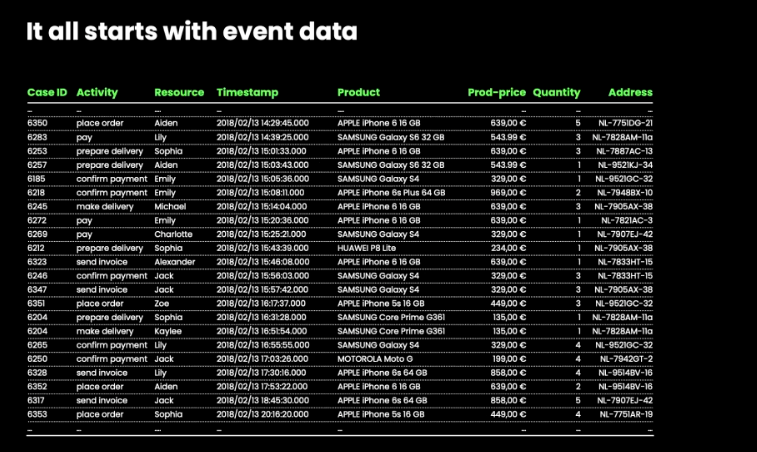
Every business process step leaves a digital footprint in Qilin.Cloud technology platform. It is using this data that our process mining software works to create a living picture of what your actual processes really look like — which does not always match the definition you might have worked out in process mapping workshops.
What are common business processes
Common business processes include Purchase-to-Pay (P2P), Order-to-Cash (O2C) or Customer Service processes, for instance. And while nearly every company has some version of these processes as the backbone of their business, there are many others that support a company’s daily operations, including:
Accounts Payable processes
Accounts Receivable processes
Procurement processes
Order Management processes
Inventory Management processes
These are just a sample, of course. Moreover, different companies define certain processes differently depending on their business needs, the systems they use, and other variables.
By their nature, processes are not static — nor do they always follow the path defined for them. Even the best-made plans go awry, and over time these deviations can become the rule without attention to continuous process improvement and business process management.
Dynamic markets also force change: customer expectations, new product lines, acquisitions, changing geographies, and any number of other things can impact a process’ ability to perform at well as it should. This is where process mining comes in, as it enables process owners to find and capture hidden value opportunities in their business processes by giving them complete real-time visibility.
The shortfalls of other technologies
BPM – Business Process Mapping
Provides some insight into processes, but it’s lengthy, subjective, and outdated as soon as it’s completed.
RPA – Robotic Process Automation
Helps you reduce man hours, but automating a poor process will get you poor results, faster.
BI – Business Intelligence
Helps you understand your data, but does not analyze root causes of process problems, and so can’t detect value opportunities and take action on them in real time.
Process Mining use cases
Process Mining use cases are almost infinite given the technology cuts across multiple business functions and industries.
For instance, process mining can make the supply chain more resilient by eliminating inefficiencies. Process mining also has a big role to play in sustainability efforts.
Any function can be made more efficient and use cases for process mining are continually evolving.
Common use cases today include:
Process excellence to uncover hidden value opportunities, fast.
Finance, to speed up transformation efforts and delivers quarter-on-quarter results.
Supply chain, to help increase resiliency.
Shared services, to drive the evolution from cost center to always-on value magnet.
System transformation, to de-risk and accelerate all phases of migration journeys.
Sustainability, to reduce shipping emissions and drive sustainable spend management.
These use cases are seen across multiple process mining customers in industries including automotive, consumer, energy, financial services, healthcare, manufacturing, professional services, retail, telco and media, life sciences, pharma, travel and transportation.
Process Mining is a business necessity
The era of ‘growth at all cost’ is over. Today, every single department in every company needs to cut costs and optimize for efficiency. Year on year, quarter on quarter, month on month.
So every department in those businesses has to optimize for efficiency. But while most departments intuitively know that their process isn’t quite working, they often don’t know how to find the value opportunities that really move the needle.
Because their tools weren’t designed for it.
What Process Mining does better
Process mining helps you capture hidden value opportunities across your core business processes.
It’s like an X-ray of your business, providing companies with the insights they need to not only visualize how their processes actually run, but understand where opportunities lie, which could have the biggest impact, and how to take action on them and measure the results.
There are several benefits to process mining. The technology enables you to:
- Get complete visibility over your processes: Get a 100% objective, real-time view of your processes based on the data your Qilin.Cloud technology platform, to find, frame, and capture value opportunities – without argument.
- Quantify the impact of process improvement: So you can demonstrate value before and after implementing a fix.
- Get stakeholder alignment: Make data-driven suggestions complete with expected ROI — driving stakeholder buy-in and alignment.
- Prioritize initiatives effectively: Prioritize and direct energy and resources as needed by quantifying the value that stands to be gained.
How does Process Mining work
Since the rise of databases and transactional systems like ERPs, companies have invested in digitizing processes and optimizing them to run more efficiently.
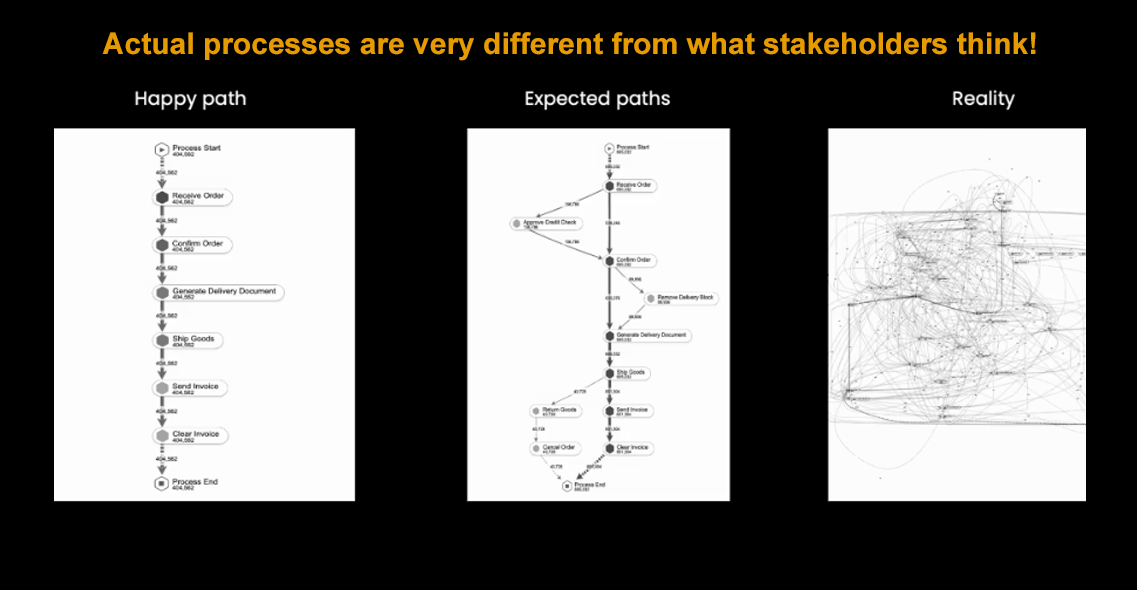
In most cases, companies have outlined the way that these processes should run in an ideal world. But the way they actually run in the real world… can be a very different story.
The problem is many organizations aren’t able to see and understand what’s happening in these processes on a day-to-day basis, so they can’t identify the difference between the process “as is” and “as expected.”
And as they say, you can’t fix what you can’t see.
Process Mining step-by-step:

Data ingestion
Modern business processes are incredibly complex. They run across a variety of systems that use different types of data, have different users, and belong to different departments.
Most process mining tools provide a few different methods for getting this data from the underlying systems. In its most basic form, a user can simply export an event log from a system as a .csv and upload it to the process mining tool. But Qilin.Cloud uses the most advanced approach to deliver real-time data ingestion to continuously sync process data by it’s own designed event logging mechanisms.
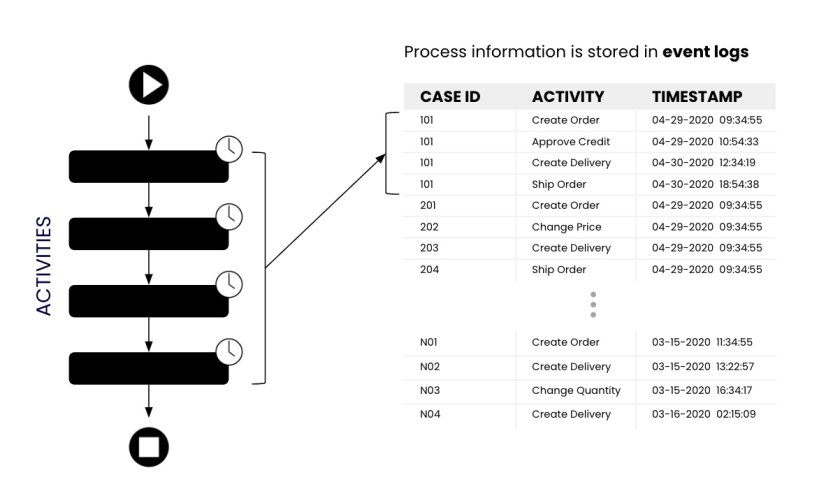
As individual business objects, or cases, within a process move through our technology platform, they leave a trail of breadcrumbs — whether it’s an invoice making its way from “requested” to “paid,” or a customer service ticket going from “submitted” to “resolved.” Throughout the stages of the cycle, these cases leave behind digital footprints, which are called events.
The Process mining technology picks up these breadcrumbs by ingesting Qilin.Cloud logs of these events and visually reconstructing what’s happening in the process.

Process discovery
Now that we’ve gathered all of our data, the magic of process mining can start to happen.
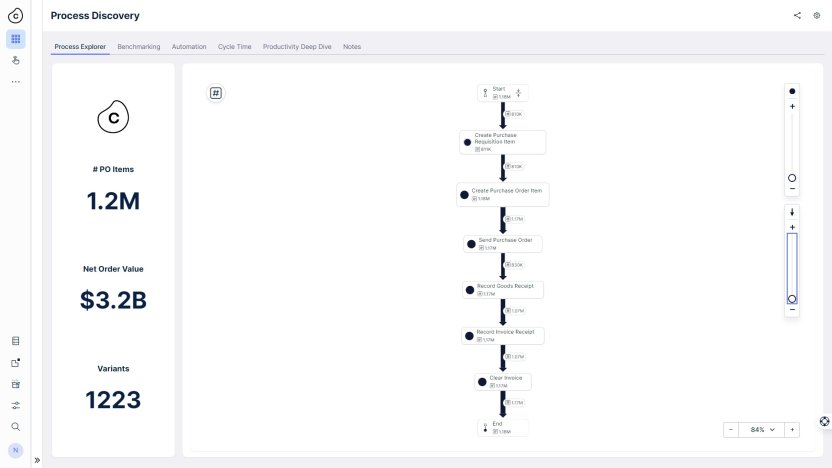
Process mining uses those event logs to produce an end-to-end visualization of the process that superimposes every step that every case took as it moved through the cycle into one visualization. This is sometimes called a digital twin of the organization.
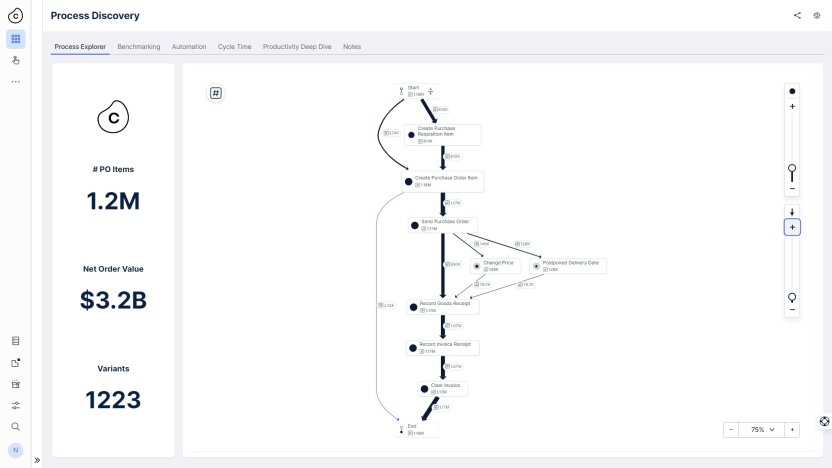
It’s a chronological sequence of events that shows all of the different paths that cases took to get from the beginning of the process to the end. Each unique path is called a variant, with variants that don’t follow a standard or accepted path being called deviations.
Process discovery allows you to explore this interactive process map and see all of the different variants.
You can zoom out and see all of the different variants, which often number in the hundreds or thousands — we affectionately refer to this as the “spaghetti” diagram.
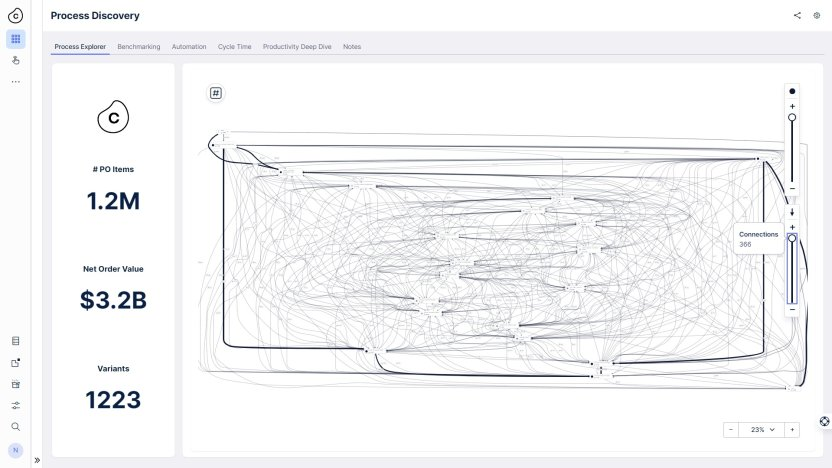
Or, you can zoom in on the happy path, which is the way we would expect the process to look and, hopefully, the most common variant.
You can slice and dice the process anyway you’d like to see how it’s really running.

Process analytics
Process analytics allow you to understand the root causes of process inefficiencies, and to quantify their impact on your KPIs.
You can start to get the answers to questions about the causes of process inefficiencies:
- Where are the bottlenecks?
- Why are cases running late?
- Which resources are overloaded?
- Which activities are often skipped?
- Which resources create deviations?
Or about the impact of process variants:
- How does a certain variant affect a process KPI like operational cost?
- How does automation, or lack thereof, impact the process cycle time?
- How does a specific business action (e.g. customer credit block) impact a business KPI (e.g. on-time delivery rate)
- What percentage of cases are conforming to the established process?
If you have assumptions about the inefficiencies, you can verify them. There are views and components that allow you to filter, slice and dice, and drill down into the data.
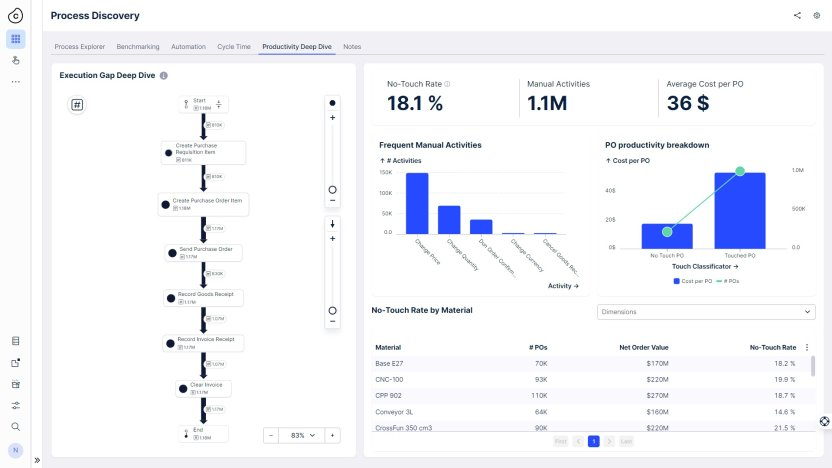
Or you can explore the process as-is and allow Qilin.Cloud to automatically surface the most impactful inefficiencies for you using AI and machine learning.

Process benchmarking
Process benchmarking allows you to compare process performance across two different dimensions.
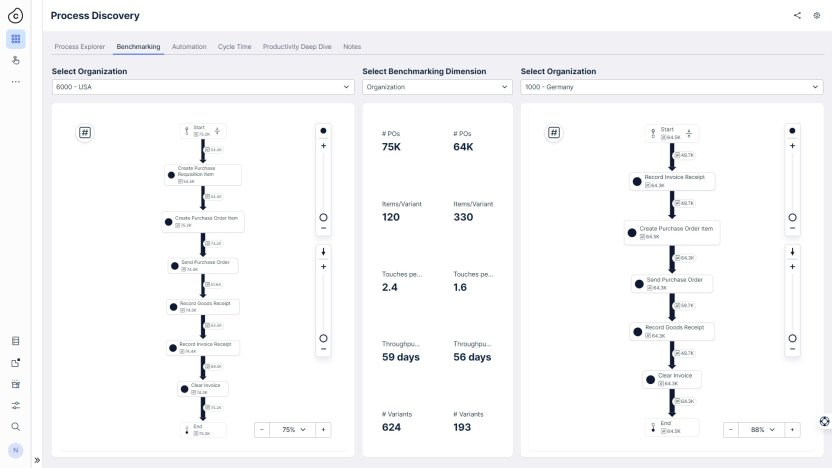
You might want to look at the time it takes to process an invoice in two different countries, or the throughput time of a purchase order from one supplier versus another.
With process benchmarking, you can start to identify best practices and share them across geographies, business units, and teams.

Conformance checking
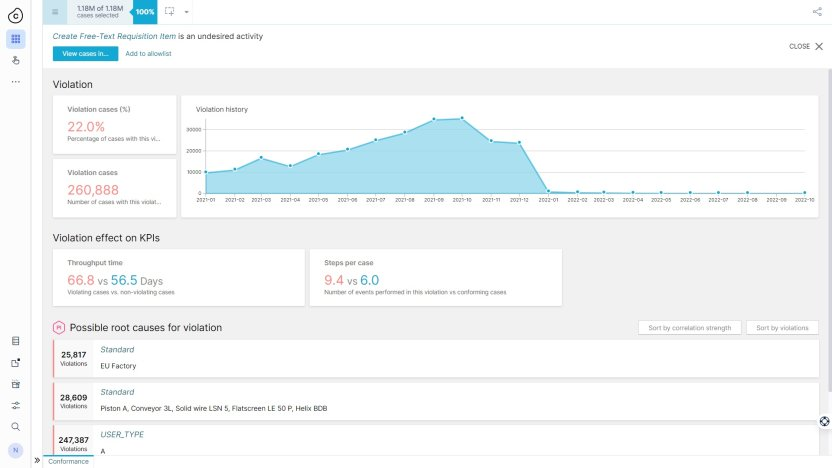
Conformance checking gives you the ability to define your preferred path, and see where processes are deviating from it.
This is where the distance between the process “as defined” and “as is” becomes clear. You can understand the percentage of cases that conform to your desired process, and the percentage that don’t. You can know intervene when steps are being skipped, executed in the wrong order, or taking longer than expected at a certain stage of the process.
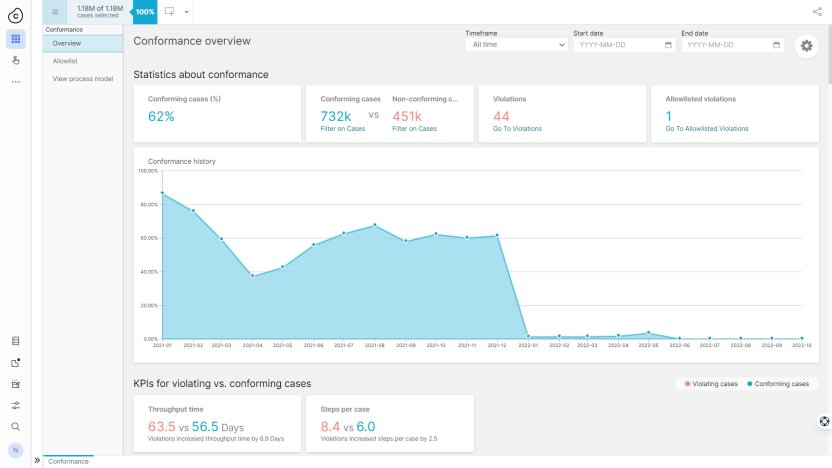
As you make improvements, conformance checking helps you measure how many more cases are running through the process in the optimal way.
How to move from Process Mining to action
Now that you know how process mining works, it’s time to move from simply understanding processes to improving them.
Once you’ve used process mining to gain visibility into a process, you can start to ask questions like:
- Where do we need to change activities or steps?
- Which activities could potentially be automated?
- How do we need to redesign the process?
- Which actions will drive better outcomes?
You’ll get the most value out of process mining by using it as part of a larger set of tools and initiatives for improving overall business execution.
Measures of process efficiency
- Reduce time
- Cut costs: Lower the amount of investment required to operate the process
- Minimize waste: Reduce the amount of resources consumed by the process
- Improve quality: Increase the total value delivered by a process
Ways to change processes
- Standardization: Reduce variations to ensure that processes are being executed in the same way across the organization
- Streamlining: Reduce the number and complexity of the steps in a process
- Optimization: Adjust the process to optimize it for a certain KPI
- Automation: Reduce the amount of human effort by automating steps and actions within a process workflow
Object-Centric Process Mining (OCPM)
The next big thing in process mining
To understand how processes are interconnected — and how to improve them holistically — early adopters have started to embrace Object-Centric Process Mining (OCPM).
OCPM is a revolutionary new approach invented by Prof. Wil van der Aalst, allowing businesses to:
- View all business activities from any perspective using a single source of truth.
- Discover new value opportunities that live at the intersection points of processes and departments.
- Move from two-dimensional views of processes to a three-dimensional and dynamic view of the entire business.
If you want to understand in details what challenges Object-Centric Process Mining solves, and how it’s going to redefine today’s execution of end-to-end business processes, read the whitepaper from our partner celonis by Prof. Wil van der Aalst: